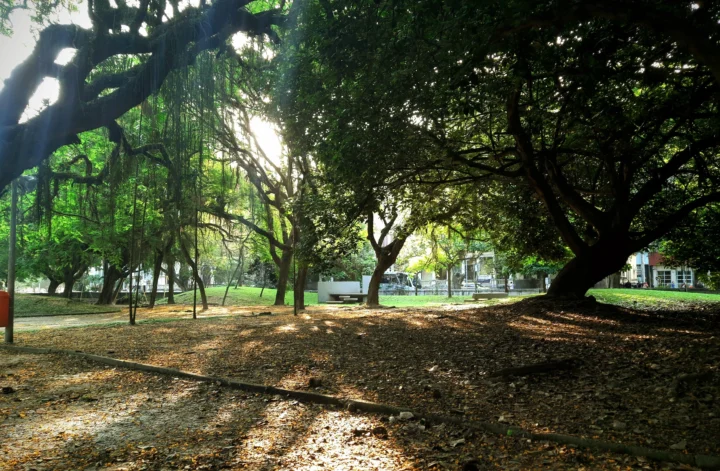
Journalled on Wednesday, 1 October 2024 | Flamengo, Rio de Janeiro, Brazil: 35 degrees, very hot, sunny, blue skies.
It is Tuesday. Today I received some messages from Alessandra, the owner of the studio flat I’m waiting to enter.
She even sent a short video with her husband showing that everything is more or less there, but still in boxes. There is also a problem with the conduits for the internet cables. They’re all full, blocked with cement.
I do not know whether it is only in Brazil, but it also seems to be the case in other countries where civil construction is sloppy and chaotic. Civil construction sites in Brazil have a reputation for being messy, with a lot of waste, and for requiring extensive cleanup at the end of the project to make everything presentable and livable.
An architect friend of mine once told me that more than 40% of the building materials used were scrap or waste, meaning that for every two buildings built, one more could have been built as well. She said this 20 years ago. Building techniques have probably improved since then.
However, I gave classes to the head construction manager of a civil engineering company, one of the most reputable builders in Rio, who confirmed the same.
A lot of mess, a lot of scrap and waste, and many mistakes due to the lack of internal communication and bad management within the organisation, and the list goes on.
At that time, his company was finishing an exclusive residential building in Leblon, probably the most exclusive neighbourhood in Rio, a bit like Mayfair or Knightsbridge in London, or the best areas of Manhattan in New York.
The 12-storey building had only one apartment on each floor. The minimum selling price for the apartments was 20 million Reais, approximately £4,000,000 at the time.
They were very high-end, exclusive homes. Although the work was complete, the project was delayed at least six months to resolve minor, avoidable issues before the apartments could be delivered to their rightful owners.
Problems and mistakes that could have been avoided, dealt with, and addressed during the build process were delayed, not addressed at the time, and pushed to the end, causing even greater delays due to difficulties, logistical problems, etc., when the building should have been finished by the deadline.
I’m not sure whether this is just in Brazil. Still, in other countries, instead of addressing the problem from the start or at that specific moment, it is preferred to roll it over multiple times until the end, usually creating more problems or making the original problems worse, and consequently causing a breakdown and failure to honour dates and deadlines.
This also applies to communication problems: internal communication is weak or even non-existent at times, causing serious mistakes, and repairing them is time-consuming and costly.
This also applies to listening. If we do not actively listen to the person who is speaking to us, whether giving directions, support, or instructions, how do we know our job, what we are supposed to do, or even how to work?
I know of stories of renowned surgeons in state hospitals in Rio who have amputated the wrong arm or leg due to either not reading the medical report properly, which is a form of not actively listening, or simply not listening to the other doctor, nurse, etc.
If we do something wrong, we need to do it twice, or even more. Imagine the patient who lost it is all her good name, and now the bad one too. How crazy is that?
Active listening is an art nowadays. People are so involved in their own little world, their own little bubble, that when someone is talking to them, they are already hearing what they expect to hear without really paying attention to the speaker.
In terms of technology, we have improved by leaps and bounds over the last 30-40 years, but our fundamental skills have not evolved to the same extent. Technology has, in an indirect, hidden, masked way, demanded more from us in this area, where basic skills and attention to detail are even more prevalent and necessary than ever before.
If we do not tune, improve, and refine these skills, we are lost in an ocean of less qualified people. The world is changing too quickly, and if we do not adapt, we are out, excluded, and in the sea, whereas the more skilled among us, the included ones, are on dry land and are not drowning like the others.
As Alexandra and her husband are having problems getting their new flat into the right condition for renting, which is often the case in Brazil, I offered to help set up the flat, and she said she would get back to me. Hopefully, by the 10th, I will have moved, as it is complicated with Nalva; we are clashing too much.
Be kind and be happy, and if you can’t be happy, still be kind, but not naïve!
In bed by 11 p.m.
Thank you.
Thanks for reading this blog post. Please explore my other posts and share your thoughts in the comments section.
Richard