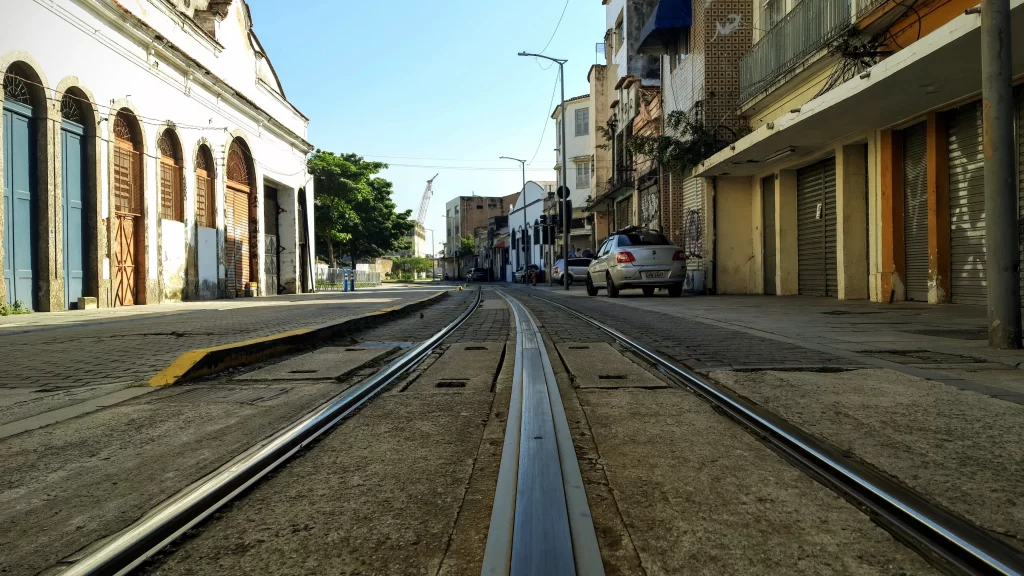
Journalled on Monday, 25 May 2026 | Santo Cristo, Rio de Janeiro, Brazil: 24 degrees, warm and overcast.
Parenthood does not become simpler when a child reaches adulthood.
The questions change, but the uncertainty remains: when should we give guidance, when should we step back, and how much of the present is shaped by the past?
It is Monday, and Yasmin returned to her mother’s this morning instead of last night. Later in the evening, her mother, Nalva, sent me a message complaining about Yasmin’s behaviour towards her. She described Yasmin as being abrupt, rude, and almost impolite, even though Yasmin was defending herself against her mother’s complaints.
I know that Yasmin is an adolescent, and adolescence can be complicated. It is a period of profound physical and psychological change, a bridge between childhood and adulthood.
I am not a psychologist, and I have not researched the subject online or elsewhere. I can only speak from my experience of raising two daughters, which has left me feeling that adolescence can be especially complicated for teenage girls.
Before travelling to England to visit my mother, I shared a flat with Nalva and Yasmin.
I had given up the flat I was renting in Copacabana because the landlady needed it back. Since my trip was already planned, I decided to move in with them rather than rent another place beforehand.
I stayed with them for almost 6 months, longer than initially planned. The first couple of months were OK, but as time passed, Yasmine began to have problems with me, and I, in turn, had problems with her.
During her school holidays, I tried to give her tasks and encourage her to take more initiative, believing it would help her. Instead, it made things worse. The atmosphere in the flat became unbearable and, at times, toxic. By the end of my stay, leaving for England felt like a relief.
Another occasion was in December of last year, when it became clear to me that Yasmin was not taking her studies seriously and that they were clearly at the bottom of her list of priorities.
When I tried to confront or even talk to her about it, she declared a passive-aggressive war against me for at least three to four months.
Only after almost six months, with a lot of patience and the dust settling, did our normal relationship return. Yasmin has told me various times that her mother and I should not be together, which I sometimes find strange, as children usually want their parents to get back together or be together.
When I have asked her about such a mentality and her way of thinking, she says that she and her mother are completely different, which, in a way, is very true. However, I feel that there is more to it. Is she jealous of one or the other?
When both are good together, does she prefer to be with us 1-to-1 rather than be with her mother, so that she does not have the relationship and attention divided in any way or form?
Or is it that if I support her mother, or her mother supports me in an action against her, she would feel intimidated, weak, vulnerable and without control?
I think it may be a little of each, or perhaps none of them. I honestly do not know. What is clear is that Yasmin is now a young woman with a very strong personality, undoubtedly inherited from both her parents. She is no longer the little girl who endured bullying, psychological abuse, or abandonment from her mother when she needed her most.
For me, this is the heart of the problem. We often reap what we planted in the past, and that is true of many things in life, including the relationships between parents and their children.
My own personal example is my mother with her two sons, my brother and me, and the respective family members, daughter-in-law’s grandchildren, etc. My mother has four grandchildren with zero contact with all of them, and what Contact they have had over the years has left almost bitter feelings on both sides.
Although I say all this, I have also come to believe that nearly every family I know is dysfunctional in one way or another. As Yasmin’s father, I want her to become a balanced, interesting and fulfilled young woman.
I know that is a lot to ask, but it is what most parents want for their children. At the same time, there is only so much that I, or any parent, can do. Eventually, we have to trust them to take responsibility for the lives they are building.
She will be 19 in June, and even though I’m there to help and guide her when she wants or needs it, she also has to do her part and pull her weight in her own life, with her own goals, aspirations and responsibilities.
As for Nalva, I have reached a point where I no longer feel responsible for her choices. That may sound harsh, but it is honestly how I feel. I am not her father, and I believe that without my help she would be in a much more difficult position today.
Am I bitter about the past? No, I am not. Perhaps I was for a while, but that belongs to the past. Now I want to enjoy whatever time life still gives me.
Be kind and be happy. If you cannot be happy, still be kind, but never be naïve.
In bed by 10 p.m.
Thank you for reading. Please explore my other posts and share your thoughts in the comments.
Richard